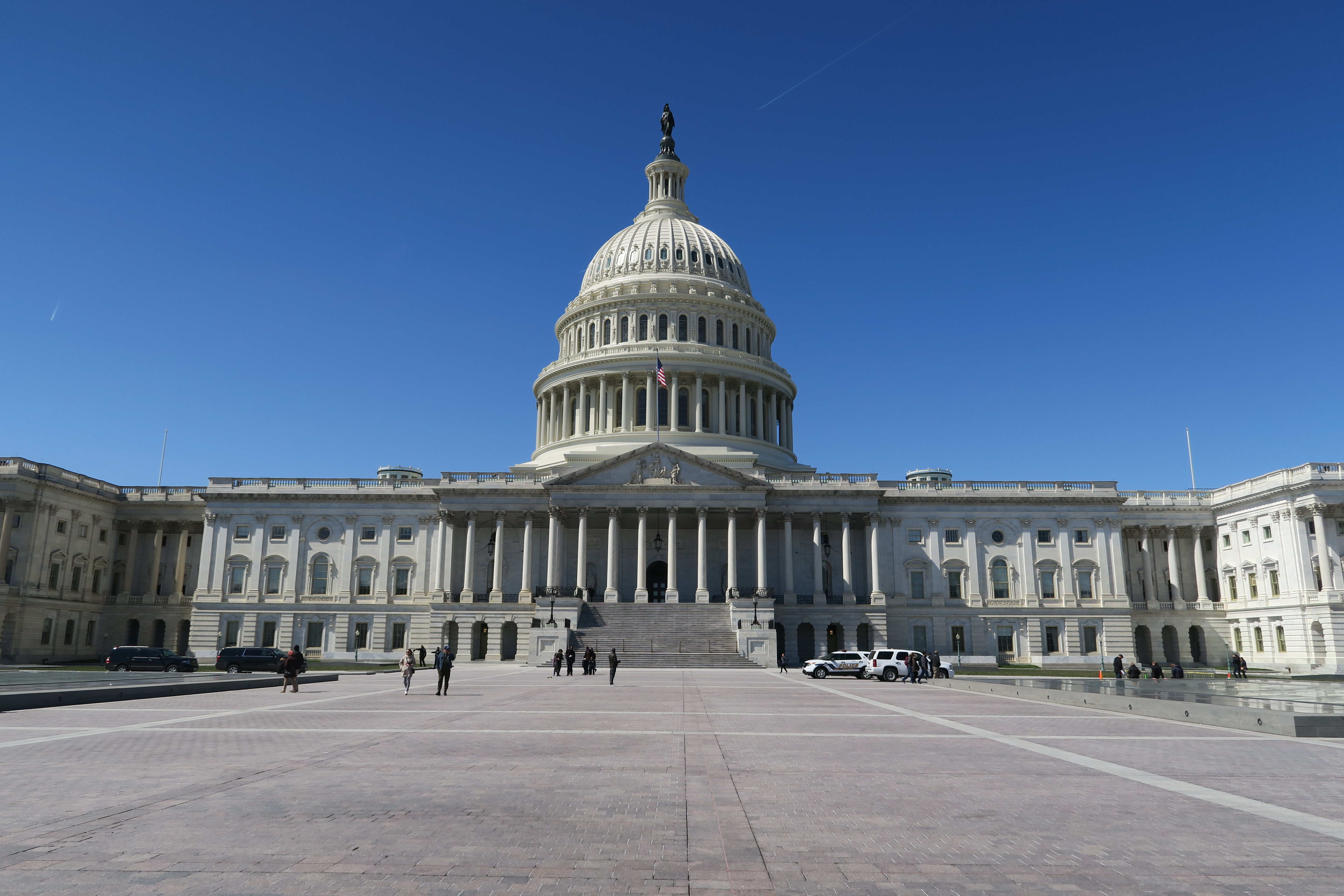
Delaware gets exactly two voices in the United States Senate, and on Tuesday, November 3, one of those two seats is on the ballot. Exactly two names are printed on it.
A United States senator serves six years as one of 100 members of the Senate, two from every state. Senators vote on federal laws and spending, confirm or reject presidential nominees — agency heads and judges, up to the Supreme Court — and they consent to treaties. Delaware’s two senators cast the same votes as any other state’s, including on the federal money that replenishes Delaware’s beaches.
The incumbent is Chris Coons, 63, of Wilmington. He grew up in Hockessin, earned degrees from Yale Law School and Yale Divinity School, and worked as an attorney for W.L. Gore & Associates. He served as president of the New Castle County Council and then as New Castle County Executive. When Joe Biden left the Senate to become vice president, Coons won the 2010 special election for the seat, then won full six-year terms in 2014 and 2020. He is asking voters for a third full term, after winning the September 15 Democratic primary with 78 percent of the vote.
His record in the Senate runs through his committees: Appropriations, Foreign Relations, Judiciary, Small Business and Entrepreneurship, and Ethics. He is Delaware’s only member of the Appropriations Committee and the ranking Democrat on its Defense Appropriations Subcommittee. The News Journal reports he helped secure more than $40 million for over 30 Delaware projects last term, including $5 million for public safety and $12 million for beach replenishment. A housing measure he introduced with Republican Senator Kevin Cramer became law in July, and he helped move bipartisan bills on bankruptcy protections, ALS research and tax penalties on Americans held hostage abroad. Other proposals he introduced, including immigration-enforcement oversight and AI transparency, have not become law.
His campaign runs under the heading “Opportunity, security and justice.” On his campaign website, Coons lists pushing back against President Donald Trump’s tariffs, defending the Affordable Care Act, transitioning to clean energy and enacting immigration reform, and he names housing, health care and everyday costs as Delaware families’ biggest pressures.
The challenger is Michael Katz, 64, known on the ballot and in his campaign as Dr. Mike Katz. He is a pediatric critical care anesthesiologist recruited from Boston Children’s Hospital to A.I. duPont Hospital for Children in 1996, and his campaign says he has spent more than four decades in medicine, with leadership roles in state and national medical societies. He holds degrees from Bates College and Georgetown University, owns a Delaware real estate company, and has lived in Delaware with his wife, Trish, for about thirty years.
Katz’s record in office comes from a different building and, at the time, a different party. Elected in 2008 as a Democrat, he represented Delaware’s 4th Senate District in Dover from 2009 to 2013. There he introduced legislation on term limits, lobbying reform, government transparency and the Delaware Health Information Network, and he co-sponsored the 2011 measure that added synthetic marijuana to Delaware’s Schedule I controlled-substance list, which the governor signed into law. His proposals to cap state spending and repeal the corporate income tax did not become law, and he lost his 2012 re-election bid. He later made a brief run for the 2020 Democratic presidential nomination, ran for this seat as an independent in 2024 and drew about 4 percent, then joined the Republican Party, whose nomination he won on September 15 with just over 77 percent of the vote. Of that change, Katz says re-registering “was not a change in principle — it was an alignment with the principles he had lived by for decades.”
His campaign’s top priorities are lowering the cost of living, reforming health care and a more fiscally responsible federal government — fiscal restraint, pro-growth tax policies and reduced regulation. On health care, he calls for more prevention and coordination among providers, expanded access in rural Kent and Sussex counties, lower prescription drug costs and expanded mental health services. On immigration, he supports completing the southern border wall in high-traffic areas, reinstating the “Remain in Mexico” policy, increasing enforcement and withholding federal funding from jurisdictions that don’t cooperate with federal immigration authorities. His platform also includes protecting Delaware’s coast, incentives for first-time homebuyers and a new advanced-care VA medical facility in Delaware.
Two names are printed on the ballot, and three more men — John Shulli, Travis Jack Stevens and William McVay — are registered as write-in candidates with the Department of Elections: their names won’t appear on the ballot, but votes written in for them will be counted.
Voting in this race is already underway. Early voting opened Thursday, October 22 and runs through Sunday, November 1 at any early voting site in your county — for Kent County readers, the closest sites are Dover’s Elks Lodge on South Saulsbury Road and Wyoming United Methodist Church, with more in Frederica and Harrington. Sites are open 7 a.m. to 7 p.m. on October 22 through 24 and again on October 26 and 27, closed on Sunday, October 25, and open 11 a.m. to 7 p.m. from October 28 through November 1. Election Day is Tuesday, November 3, with polls open 7 a.m. to 8 p.m. at your assigned polling place. Your sample ballot and polling place are at the state’s voter portal, ivote.de.gov.
Brought to you by Team Murphy Media
If you’d like us to continue this work and keep Shop Talk Weekly subscriptions free, consider making a donation: Cash App $dj7309 · PayPal paypal.me/dj7309. Can’t donate? Like, share & subscribe — that costs nothing and means everything.